
When you decide to get your HR (Heavy Rigid) licence in South Australia, one of the first decisions you will face is which transmission type to train and test in. Automatic, manual synchromesh, or road ranger. Each one opens different doors, suits different learners, and carries different weight with employers across Adelaide and regional SA.
The choice is not purely about what is easiest to learn. It is about matching your training to the kind of work you actually want to do. Get this right early and you avoid paying for additional training down the track.
Key Takeaways
- An automatic HR licence is the simplest to obtain but restricts you to automatic vehicles only.
- A manual synchromesh HR licence is the industry standard and covers the broadest range of rigid truck roles.
- A road ranger endorsement is required for non-synchromesh vehicles and unlocks the most specialised HR roles.
- You can upgrade from automatic to manual or road ranger after gaining your initial licence.
- Your choice should be guided by the work you are targeting, not just training convenience.
Understanding the Three HR Licence Types
Australia’s HR licence authorises you to drive vehicles with a GVM over 8 tonnes with more than two axles. But within that class, the transmission type you train and test in determines what you are actually licenced to operate day to day.
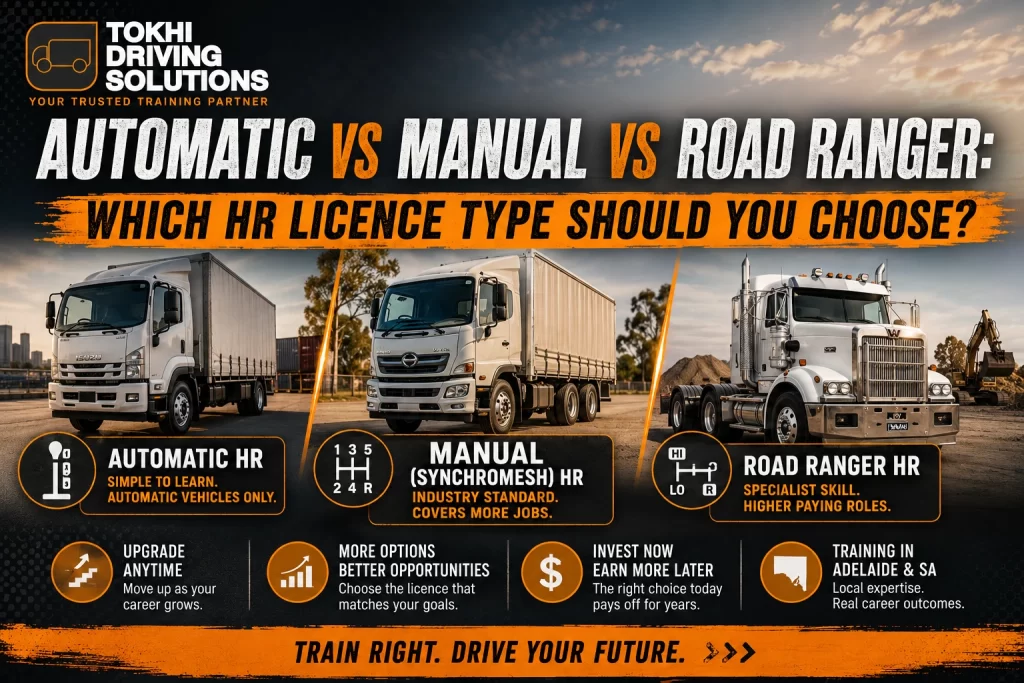
In South Australia, the three main options are:
- Automatic HR – tested and qualified in an automatic transmission truck
- Manual (synchromesh) HR – tested in a synchromesh manual gearbox truck, the most common type in the industry
- Road Ranger (non-synchromesh) HR – a separate endorsement for vehicles fitted with road ranger or range-change gearboxes
Automatic HR: Simple Entry, Narrower Options
Automatic trucks are increasingly common in Australian fleets, particularly in urban logistics, waste management, and local delivery. Training on an automatic is genuinely easier for candidates who have limited experience with heavy vehicles. The gear management component disappears entirely, which removes one of the more stressful parts of the practical test.
Automatic truck training in Adelaide suits people who are new to heavy vehicles, returning to trucking after a career break, or targeting specific roles where automatic trucks are standard. Think council waste collection, concrete delivery, and urban distribution work.
The trade-off is real, however. An automatic-only HR licence restricts you to automatic vehicles. If an employer runs a mixed fleet, or if their trucks are manual, you will not be eligible. You would need to resit the practical test in a manual vehicle to have that restriction removed.
Best suited for:
- First-time heavy vehicle drivers
- Roles in urban delivery or waste management
- Drivers who want a quicker path to their first HR qualification
Manual (Synchromesh) HR: The Industry Standard
A manual synchromesh HR licence is what the majority of HR-qualified drivers in Australia hold. Synchromesh gearboxes are found across a large proportion of the rigid truck fleet, and qualifying in one means you can legally operate both manual and automatic HR vehicles without restriction.
The skill curve is higher than automatic. You need to manage clutch control, gear selection under load, hill starts, and smooth gear changes throughout the practical test. Candidates who go in without sufficient vehicle hours often struggle with this during the assessment.
That said, training in a manual truck builds a stronger overall foundation for heavy vehicle driving. The habits you develop around anticipating gear changes, managing engine revs, and reading how the vehicle responds under load transfer into safer driving across all conditions. It also gives you a much stronger base if you plan to upgrade toward higher licence classes in the future.
If you want to understand both options before committing, the HR truck driving course in Adelaide covers automatic and manual training pathways depending on your goals and starting point.
Best suited for:
- Drivers targeting the widest range of employment options
- Those planning to move up the licence hierarchy later
- Candidates with some prior manual driving experience
Road Ranger (Non-Synchromesh): The Specialist Option
A road ranger gearbox works fundamentally differently to a synchromesh manual. There is no synchromesh mechanism to smooth the gear change for you. Shifting cleanly without grinding requires you to match engine revs precisely and use the double-clutch technique on every gear change. It takes longer to learn, but it is a skill that a significant portion of the driver workforce does not hold.
The road ranger licence in Adelaide is an endorsement that sits on top of your existing HR or higher licence. It qualifies you to operate vehicles fitted with road ranger, Eaton Fuller, or other range-change non-synchromesh gearboxes. These gearboxes are found in some of the heavier, older, and more specialised rigid trucks used in freight, civil construction, and bulk transport across SA.
Drivers who hold this endorsement are in shorter supply than standard manual HR holders, and that scarcity shows up in job opportunities and pay rates. The double-clutch technique required for these vehicles is a learnable skill. With structured training it becomes natural fairly quickly, and the investment pays off over a career.
Best suited for:
- Experienced drivers looking to increase their earning potential
- Those targeting civil construction, mining support, or bulk freight roles
- HR holders who want to stand out in a competitive driver market
Side-by-Side Comparison
| Automatic HR | Manual Synchromesh HR | Road Ranger HR | |
| Difficulty to learn | Low | Medium | High |
| Vehicles covered | Automatic only | Auto and synchromesh manual | Auto, manual, and non-synchromesh |
| Employer demand | Moderate | High | High (specialist) |
| Training time | Shorter | Standard | Longer |
| Typical roles | Urban delivery, waste | Freight, logistics, civil | Construction, bulk, specialist freight |
| Can upgrade later | Yes | Yes (road ranger) | No (top of HR class) |
Key Factors to Consider When Choosing
What Jobs Are You Targeting?
This is the most important question. Local delivery or council work, automatic may cover you. Freight, civil construction, or regional work, manual synchromesh is the practical minimum. Specialist roles with higher pay, road ranger training is worth the extra investment.
Your Current Experience Level
If you have never driven a heavy vehicle, starting with automatic is a reasonable first step. It gets you licenced, earning, and building vehicle hours. You can return for manual or road ranger training once you have built familiarity with heavy vehicle handling. If you already have some truck experience, going straight to manual synchromesh or road ranger is generally better value.
Training Cost vs Long-Term Return
Automatic training carries the lowest upfront cost. Manual costs more and road ranger more again. But drivers who limit themselves to automatic-only often pay for extra training later when job options narrow. Starting with a broader qualification tends to work out better value across a career than upgrading in stages.
Future Licence Upgrades
If you are planning to move toward MC (Multi-Combination) or other higher classes eventually, starting with manual synchromesh gives you the strongest platform. Road ranger experience is also an advantage for drivers heading toward prime mover roles, even though those require separate testing.
Career and Employment Outlook in South Australia
Demand for qualified HR drivers across Adelaide and regional SA remains strong across freight, construction, and local government sectors. Manual HR drivers represent the largest share of job postings, but road ranger-qualified drivers are harder to find and can command better rates for specialist work.
Automatic-only drivers find consistent work in urban roles, but some freight employers and labour hire companies require at minimum a manual synchromesh qualification before they consider candidates.
The broader your qualification, the more flexible your employment options. Starting with automatic and upgrading is a valid path. Going straight to manual or road ranger where your experience allows gets you to that flexibility faster and at lower total cost.
Conclusion
Choosing between automatic, manual, and road ranger HR training comes down to one question: where do you want to be working in two years, not just next month? Automatic gets you started. Manual opens broader doors. Road ranger gives you specialist capability and stronger earning potential over a career.
Think ahead when you choose, and train to where you want to go, not just where you are now. If you want practical guidance on the right pathway for your situation and goals, Tokhi Driving Solutions can walk you through your options and set you up with the right training from the start. Book a session today and get the advice you need before you commit to a direction.
FAQ
Yes. If you qualify in an automatic, you can later sit an additional practical test in a manual synchromesh vehicle to remove the automatic restriction. It is a straightforward process through Service SA once you are ready to sit for it.
It does cost more than standard manual training because the non-synchromesh technique requires more development time and additional practice sessions. For most drivers, the access to higher-paying specialist roles offsets this cost within a relatively short time in employment.
Yes. A manual synchromesh HR licence or road ranger endorsement covers automatic vehicles as well. The restriction only applies in the other direction. An automatic-only HR licence does not cover manual vehicles.
This varies by starting point. Drivers who already hold a manual HR licence and have solid vehicle hours typically progress more quickly. Candidates with limited prior manual truck experience need more time. Your instructor can give you a realistic estimate after an initial assessment of where you are starting from.
Most freight and logistics employers prefer at minimum a manual synchromesh HR licence. Civil construction and bulk transport roles often require or prefer road ranger-qualified drivers. Automatic-only candidates are generally well suited to urban delivery and council-sector roles.
Yes. While newer trucks increasingly use synchromesh or automated transmissions, road ranger gearboxes remain in active use across construction fleets, bulk haulage, and some freight operations throughout SA. The endorsement continues to carry genuine practical value in the current job market.