
Whether you’ve just earned your HR truck licence in Adelaide, you’re working towards one, or you’re planning your next career move in the transport industry, one of the most common questions we hear at Tokhi Driving Solutions is: “What’s the biggest truck I can actually drive with my HR licence?”
It’s a question that matters. The answer directly affects the jobs you qualify for, the pay rates you can negotiate, and how far your career in South Australia’s transport and logistics sector can take you.
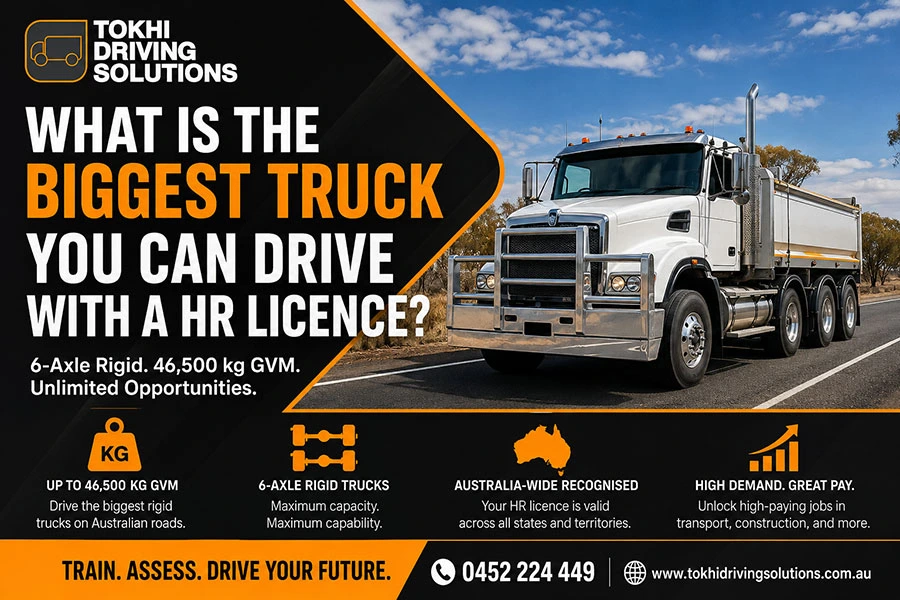
The short answer? With a Heavy Rigid (HR) licence, you can legally drive a 6-axle rigid truck with a Gross Vehicle Mass (GVM) of up to 46,500 kg, as defined by the National Heavy Vehicle Regulator (NHVR).
But the full picture is more interesting than just a number. In this guide, we’ll walk you through exactly what the HR licence covers, how Australian vehicle mass and dimension limits work, what types of trucks fall into this class, and what it means for your career as a professional driver in South Australia.
What is an HR Licence in Australia?
A Heavy Rigid (HR) licence is the highest level of rigid vehicle licence available in Australia’s graduated heavy vehicle licensing system.
Under the national framework administered by the National Heavy Vehicle Regulator (NHVR), a heavy rigid vehicle is defined as:
- A single-unit, rigid chassis vehicle (not articulated, meaning there is no pivot point between cab and body)
- With three or more axles
- With a Gross Vehicle Mass (GVM) exceeding 8,000 kg
Your HR licence also permits you to tow a single trailer with a GVM not exceeding 9,000 kg, which is worth noting as this can significantly extend your load capacity on certain jobs.
What it does not cover is articulated trucks (semi-trailers), which require an HC (Heavy Combination) licence, or road trains and B-doubles, which require an MC (Multi Combination) licence.
In South Australia, the HR licence is issued by the SA Registrar of Motor Vehicles under the Motor Vehicles Act 1959, with national consistency provided by the NHVR framework that operates across all states and territories.
Australia’s Truck Licence Hierarchy: Where Does HR Fit?
To fully appreciate what the HR licence allows, it helps to understand where it sits in Australia’s stepped licensing system:
| Licence Class | What You Can Drive | Notes |
| C (Car licence) | Cars, light vans | Up to 4,500 kg GVM |
| LR (Light Rigid) | 2-axle rigid vehicles | GVM > 4,500 kg |
| MR (Medium Rigid) | 2-axle rigid vehicles | GVM > 8,000 kg |
| HR (Heavy Rigid) | 3+ axle rigid vehicles | GVM > 8,000 kg (highest rigid class) |
| HC (Heavy Combination) | Articulated trucks (semi-trailers) | Prime mover + trailer |
| MC (Multi Combination) | Road trains, B-doubles | Largest combination vehicles |
Source: National Heavy Vehicle Regulator (NHVR)
The HR licence is the ceiling of the rigid vehicle class. Once you hold an HR, the next logical progression is to HC, which opens the door to semi-trailer driving and significantly more job opportunities across Australia.
What Vehicles Can You Actually Drive With a HR Licence?
Beyond just “big trucks,” the HR licence covers a wide and practical range of vehicles used across multiple industries in South Australia:
Trucks and Freight Vehicles
- 3, 4, 5, and 6-axle heavy rigid trucks
- Rigid tipper trucks (construction and civil works)
- Refrigerated rigid trucks (food and pharmaceutical distribution)
- Crane trucks with rigid chassis
- Flat deck rigid trucks
- Side-loader trucks
Specialist and Industrial Vehicles
- Concrete agitator trucks (concrete mixers)
- Water tankers (agriculture and civil construction)
- Fuel tankers (rigid configuration)
- Waste compactor trucks (council and commercial waste)
- Hook-lift/skip bin trucks
Passenger Transport
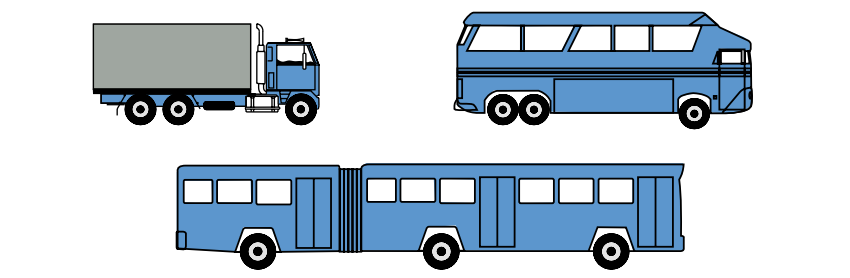
- Large buses meeting the HR classification (3+ axles, GVM > 8,000 kg)
- Coach vehicles in certain configurations
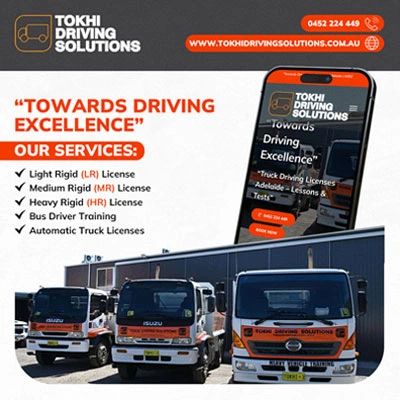
If you’re interested in bus driving specifically, Tokhi Driving Solutions also offers dedicated bus driver training in Adelaide to help you qualify for that sector.
What You Cannot Drive on a HR Licence:
- Prime mover + semi-trailer combinations (requires HC)
- B-doubles (requires MC)
- Road trains (requires MC)
- Any trailer with a GVM exceeding 9,000 kg
The Biggest Truck You Can Drive With a HR Licence: The Full Breakdown
Now to the main event.
Under the NHVR’s General Mass Limits (GML) framework, the maximum allowable GVM for a rigid vehicle is determined by the number of axles. Each additional axle distributes more load across the road surface, which is why higher axle counts are permitted to carry greater mass.
NHVR General Mass Limits for Rigid Vehicles
| Number of Axles | Maximum GVM (kg) | Common Vehicle Types |
| 2 axles | 16,500 kg | LR/MR trucks, small rigids |
| 3 axles | 26,500 kg | Concrete agitators, small tippers |
| 4 axles | 33,000 kg | Heavy tippers, water tankers |
| 5 axles | 40,000 kg | Large tippers, specialist vehicles |
| 6 axles | 46,500 kg | Maximum for HR licence |
Source:NHVR General Mass Limits, National Heavy Vehicle Regulator
The answer: A 6-axle rigid truck with a GVM of 46,500 kg is the largest vehicle you can drive on a HR licence in Australia.
To put that in everyday terms: 46,500 kg is roughly the combined weight of 30 average family cars. That’s a serious machine, and it demands serious training.
Understanding the 6-Axle Rigid Truck
A 6-axle rigid truck is not something you’ll see every day in suburban Adelaide, but they are a genuine and important part of South Australia’s heavy transport fleet.
Typical Axle Configuration
A 6-axle rigid truck in Australia typically includes:
- 1 steer axle — the front axle controlling direction
- 2 tandem drive axles at the rear providing power
- 3 additional load-spreading axles (tag or pusher axles) that spread weight across the road surface
The extra axles aren’t just about carrying more weight. They’re a road protection measure. By spreading the load over more points of contact, these trucks reduce the pavement stress that causes road damage, which is why the NHVR allows them to carry more.
Legal Dimensions for HR Rigid Vehicles in Australia
Under the NHVR Heavy Vehicle (Mass, Dimensions and Loading) National Regulation, rigid vehicles must comply with the following maximum dimensions:
| Dimension | Maximum Allowed |
| Overall length | 12.5 metres |
| Overall width | 2.5 metres |
| Overall height | 4.3 metres |
| Front overhang | 1.25 metres |
| Rear overhang | The lesser of 3.7 metres or 60% of the wheelbase |
Source: NHVR Dimension Limits for Rigid Vehicles
So at maximum, a 12.5 metre long, 2.5 metre wide, 4.3 metre tall vehicle weighing up to 46,500 kg is what your HR licence authorises you to operate. That’s the complete picture.
Towing a Trailer With a HR Licence: What You Need to Know
One of the most overlooked advantages of the HR licence is the ability to tow a trailer, which can considerably increase your earning potential and the types of work available to you.
Your HR licence permits:
- Towing a single trailer with a GVM of up to 9,000 kg
- Operating a rigid truck and dog trailer combination (common in South Australian agriculture and bulk haulage)
- Using the trailer for freight, equipment, or liquid haulage, provided the trailer meets roadworthiness standards
Important conditions to observe:
- The total combination must comply with NHVR combination length limits
- The trailer coupling and safety chains must meet Australian Design Rules (ADR)
- The combined vehicle GVM and axle loads must not exceed individual axle mass limits
- A current trailer registration is required
This combination capability makes the HR licence particularly valuable in regional South Australia, where bulk grain, livestock, and liquid agricultural transport often uses rigid truck and dog configurations.
HR Licence vs HC Licence: The Difference That Matters for Your Career
Many people confuse the HR and HC licences, or wonder whether it’s worth going straight for HC after MR. Here’s a clear side-by-side:
| Feature | HR Licence | HC Licence |
| Vehicle type | Single-unit rigid (no articulation) | Articulated (prime mover + trailer) |
| Maximum GVM | 46,500 kg (rigid only) | Dependent on combination |
| Trailer towing | Up to 9,000 kg GVM | Full semi-trailer (no upper GVM limit within class) |
| Typical vehicles | Tipper, agitator, bus, crane truck | Semi-trailer, B-train prime mover |
| Road train/B-double | Not permitted | B-double permitted with HC |
| Pathway | MR to HR | HR to HC (HR is a prerequisite) |
| Job market | Construction, waste, bus, agriculture | Linehaul, interstate freight, warehousing |
The HR licence is a mandatory stepping stone to HC. You cannot get an HC licence without first holding HR. So even if your ultimate goal is to drive semi-trailers, the HR licence is a key part of your journey, not a detour.
Our team at Tokhi Driving Solutions can help you map out the right progression for your specific career goals.
SA-Specific HR Licence Requirements
In South Australia, the HR licensing pathway is governed by the Motor Vehicles Act 1959 (SA) and is consistent with the national framework administered by NHVR.
Eligibility Checklist for HR Licence in SA
Before you can sit your HR assessment, you must:
- Hold a current MR (Medium Rigid) licence, or hold an equivalent interstate licence
- Be at least 18 years of age
- Meet the medical fitness standards for heavy vehicle drivers (as set by Austroads)
- Pass a practical competency assessment, either a VORT or a TiLE program
What is a VORT?
A VORT (Vehicle On-Road Test) is a practical, on-road competency assessment conducted by an authorised examiner. At Tokhi Driving Solutions, Arjun Tokhi is an authorised examiner for LR, MR, and HR licences, meaning you can complete your training and your assessment with the same experienced instructor. No separate booking, no unfamiliar examiner, no extra stress.
What is a TiLE?
A TiLE (Training in Lieu of Experience) is a structured competency-based training and assessment program that allows drivers to progress through licence classes via a formal training pathway, rather than relying on extended experience periods alone. TiLE is a popular route for career changers or people looking to accelerate their licencing timeline.
What is CBT&A?
CBT&A (Competency Based Training and Assessment) is the formal educational framework that underpins heavy vehicle licensing in Australia. Our HR truck licence training in Adelaide is designed to meet all CBT&A requirements, so you’re assessed against nationally recognised competency standards.
What Industries Use 6-Axle HR Trucks in South Australia?
If you’re considering the HR licence as a career move, it helps to know where the actual jobs are. Here are the key sectors in SA that regularly employ HR-licensed drivers operating large rigid vehicles:
Civil Construction and Infrastructure
South Australia’s ongoing investment in road, rail, and urban infrastructure creates continuous demand for rigid tipper truck drivers. 6-axle tippers are essential for moving large volumes of crushed rock, fill, asphalt, and spoil on major projects across greater Adelaide.
Resources and Mining
The Olympic Dam mine near Roxby Downs, and broader mining activity across SA’s outback, relies on heavy rigid vehicles for surface haulage, water carting, and site logistics. Road-registered 6-axle rigids are a core part of that fleet.
Agriculture and Bulk Haulage
South Australia is a major grain-producing state, and the Upper North, Mid North, Riverland, and South East regions all rely on HR drivers to move bulk commodities during harvest season and beyond. Large rigid tankers and tippers are the bread and butter of rural SA transport.
Waste Management and Council Services
Adelaide metro and regional councils rely on HR-licensed drivers to operate rear-loader compactors, hook-lift trucks, and recycling vehicles. This sector offers consistent, year-round employment.
Concrete and Construction Materials
Concrete agitator trucks (commonly known as concrete mixers) in Adelaide’s residential and commercial construction markets are a steady source of employment for HR drivers. These vehicles frequently operate in the 3-4 axle range but can reach 5-6 axles on large pour jobs.
Emergency Services
Many large fire trucks, aerial platforms, and tanker appliances operated by the South Australian Metropolitan Fire Service (MFS) and the Country Fire Service (CFS) fall under the HR vehicle classification.
What Does a HR-Licensed Truck Driver Earn in South Australia?
Let’s talk money, because the HR licence is not just a piece of plastic. It’s an investment in your earning capacity.
| Role | Typical Annual Salary (SA) | Reference |
| HR Truck Driver (general) | $70,000 – $85,000 | Seek.com.au, 2025 |
| HR Tipper Driver (civil construction) | $80,000 – $98,000 | Seek.com.au, 2025 |
| HR Concrete Agitator Driver | $75,000 – $92,000 | Indeed.com.au, 2025 |
| HR Waste Management Driver | $72,000 – $86,000 | LinkedIn Jobs SA, 2025 |
| HR Bus Driver (metro/regional SA) | $68,000 – $82,000 | Seek.com.au, 2025 |
| HR Driver (Agriculture/Regional) | $85,000 – $105,000+ | Seek.com.au, 2025 |
Note: Figures are indicative ranges based on advertised roles. Regional and remote SA positions, DIDO (drive-in, drive-out) arrangements, and shift allowances can push earnings considerably higher.
The demand for HR-licensed drivers in South Australia continues to outpace supply. According to the Australian Bureau of Statistics (ABS), the road freight transport industry employed approximately 155,000 Australians as of 2023-24, with consistent forecasting of labour shortages in the heavy vehicle sector.
The National Centre for Vocational Education Research (NCVER) also identifies heavy vehicle driving as one of the ongoing skills shortage areas in South Australia’s infrastructure, construction, and logistics sectors.
In short: this is a licence that pays for itself quickly and keeps paying for years.
How to Get Your HR Licence in Adelaide with Tokhi Driving Solutions
At Tokhi Driving Solutions, our HR licence training is built around one goal: giving you genuine confidence behind the wheel of a heavy rigid truck, not just enough to pass a test and struggle on day one of a real job.
Here’s how our training process works:
Step 1: Check Your Eligibility
You’ll need a current MR licence. If you’re starting from scratch, we offer a clear progression pathway, beginning with LR truck licence training, moving through MR truck licence training, and then on to HR. We’ll advise you on the most efficient route.
Step 2: Book Your Training Sessions
We offer flexible scheduling Monday to Saturday, 8 AM to 8 PM, with same-week availability in many cases. Whether you’re working full-time or available during the week, we can work around your schedule.
Step 3: Complete Practical Training
Your training will cover everything you need to operate HR vehicles safely and confidently:
- Pre-trip vehicle inspection, checking tyres, brakes, lights, fluid levels, and load security
- Vehicle controls and instruments, understanding the dash, mirrors, and safety systems
- Gear operation, covering synchromesh, road ranger, and automatic gearboxes depending on your goals
- Safe braking and load awareness, understanding stopping distances and load distribution at high GVMs
- Low-speed manoeuvring, reversing into bays, navigating tight turns and construction sites
- Road positioning and lane management, handling a large vehicle in traffic and on country roads
- Hazard perception and defensive driving, the situational awareness skills that keep you and others safe
Step 4: Complete Your Authorised Assessment
Because Arjun Tokhi is an authorised examiner for HR licences in South Australia, your formal assessment takes place with us. No need to book a separate government examiner, and no unfamiliar environment on test day. This streamlines your process considerably.
Your Gearbox Options: An Important Choice for Career Flexibility
Not all HR licences are equal. If your licence is issued with gearbox restrictions, you may be limited in the jobs you can apply for.
At Tokhi Driving Solutions, we offer training for:
- Automatic Truck Licence, ideal for modern automatic fleets
- Double Clutch Licence, essential for older synchromesh gearboxes
- Road Ranger Licence, required for range-change gearboxes common in heavy construction fleets
- Unrestricted HR Licence, covers all gearbox types and gives you maximum employability
We strongly recommend working towards an Unrestricted HR licence if you’re serious about maximising your career options. Many employers in SA’s civil construction and agriculture sectors specifically require road ranger or synchromesh capability.
Why Tokhi Driving Solutions Is the Right Choice for HR Training in Adelaide
There are a number of truck training schools in South Australia, but here’s what sets us apart:
Authorised Examiner: Train and Test in One Place
Arjun Tokhi is one of a relatively small number of authorised examiners for LR, MR, and HR licences in South Australia. This means your assessment is conducted by someone who has also trained you, who knows your strengths and has prepared you specifically for the assessment criteria.
Over 1,000 Drivers Trained
With more than 7 years of experience and over 1,000 learner drivers trained in South Australia, Arjun brings a depth of real-world knowledge that textbooks can’t replicate. He knows the roads, the assessments, and the common mistakes that hold candidates back.
Multi-Language Instruction
Arjun teaches in English, Hindi, and Punjabi, making Tokhi Driving Solutions one of the most accessible driving schools for Adelaide’s diverse multicultural community.
Industry Partnership
We are the official successor and partner to Allan Miller Transport Training, one of South Australia’s longest-established and most respected truck training providers. When Allan Miller changed their business model, they specifically partnered with Arjun Tokhi to continue their legacy of quality training.
Comprehensive Qualification Pathway
Whether you’re starting with an LR, progressing through MR, or going all the way to HR with unrestricted gearbox options, we support your full licencing journey under one roof.
The Bottom Line
The biggest truck you can legally drive with a HR licence in Australia is a 6-axle rigid vehicle with a GVM of 46,500 kg and a maximum length of 12.5 metres, as defined under the NHVR General Mass Limits framework.
That’s a powerful, purpose-built machine used in some of South Australia’s most important industries, including civil construction, agriculture, mining, and logistics. And the demand for HR-licensed drivers qualified to operate them is only growing.
But the licence is only as good as the training behind it. Knowing you can drive the biggest truck in the class is one thing. Being confident, competent, and job-ready the day you sit in the cab is another.
That’s the difference Tokhi Driving Solutions makes.
Frequently Asked Questions About the HR Licence and Biggest Trucks
Yes. Your HR licence authorises all vehicles within the HR class from day one, including 6-axle trucks up to 46,500 kg GVM. In practice, most employers will require an induction period and you’ll typically start on smaller rigids, but there is no legal restriction.
Yes. Buses that meet the HR vehicle classification, being three or more axles and a GVM exceeding 8,000 kg, can be driven on an HR licence. For dedicated bus driving careers, we also offer bus driver training in Adelaide.
Yes. Under the national mutual recognition framework, your SA HR licence is fully valid in all other states and territories of Australia.
Most students with current MR experience complete their HR training within 1 to 3 days of practical sessions. The total time depends on your prior experience and confidence level with larger vehicles.
An HR licence covers the largest rigid (single-unit) trucks, up to 46,500 kg GVM. An HC licence covers articulated vehicles, where the GVM potential is considerably higher because you add a full semi-trailer to the prime mover. If maximum payload potential is your goal, HC is the next step after HR.
Yes. Your HR licence covers metropolitan Adelaide, regional SA roads, and dirt/unsealed roads, provided the vehicle meets any road access conditions set by local councils or the NHVR for specific routes.
In some cases, this may be possible if the vehicle meets training requirements. Contact us directly on 0452 224 449 to discuss your specific situation.
A restricted HR licence limits you to a specific gearbox type (for example, automatic only). An Unrestricted HR licence allows you to legally operate any HR vehicle regardless of gearbox, whether synchromesh, road ranger, or automatic. Unrestricted is the recommended option for career drivers.