
Most candidates who fail the HR licence test do not fail because they cannot drive. They fail because they did not know what the examiner was specifically looking for, or they walked in without understanding the test format.
Getting your Heavy Rigid (HR) licence in South Australia creates strong career opportunities across freight, logistics, and civil works. But the test has specific requirements that catch many people off guard, particularly the pre-trip vehicle inspection. This guide covers exactly what you need to know to pass your HR test in Adelaide on the first attempt.
Key Takeaways
- The HR test in SA includes a computer-based knowledge test and a practical on-road assessment.
- The pre-trip vehicle inspection is a scored component and must be completed in a structured sequence.
- Most first-attempt failures come from predictable, avoidable mistakes.
- You must meet licence prerequisites and may need a medical assessment before booking through Service SA.
- Hands-on training in the correct vehicle type is the single biggest factor in passing the practical test.
What Is the HR Licence in South Australia?
A Heavy Rigid (HR) licence authorises you to drive vehicles with a Gross Vehicle Mass (GVM) greater than 8 tonnes with more than two axles. This covers large rigid trucks, concrete mixers, garbage trucks, and multi-axle rigid vehicles used across construction and transport industries.
HR sits above MR (Medium Rigid) in the licence hierarchy. For a breakdown of all licence classes and what each one covers, the truck licence classes descriptions page is a useful starting point. If you want to understand the career value of holding this class, the article on what you can drive with an HR licence in Adelaide outlines the vehicle types and job opportunities clearly.
HR Licence Requirements Before You Book Your Test
Before booking your test, confirm you meet the following requirements:
- Hold a current Class C car licence or the appropriate lower commercial licence.
- Be at least 18 years of age.
- Have held your current licence class for at least one year in most cases.
- Satisfy any applicable medical fitness requirements.
- Pass the knowledge test before attempting the practical.
For the full eligibility breakdown, the HR truck licence requirements Australia guide covers each criterion in detail. Always confirm current requirements with Service SA directly before booking, as rules can change.
Understanding the HR Licence Test Format
The Knowledge (Theory) Test
The knowledge test is computer-based and covers road rules, heavy vehicle regulations, load restraint, fatigue management, and safe following distances. It draws from the SA Road Rules handbook. You cannot sit the practical until you pass this component.
Do not rely on your general car licence road knowledge. The heavy vehicle-specific sections require targeted study, particularly load restraint responsibilities and fatigue rules under national legislation.
The Practical On-Road Test
The practical test is conducted in an actual heavy rigid vehicle with an approved Service SA testing officer. It assesses three areas: the pre-trip vehicle inspection, basic handling skills (reversing and turning), and on-road driving across varied traffic conditions.
The Pre-Trip Vehicle Inspection
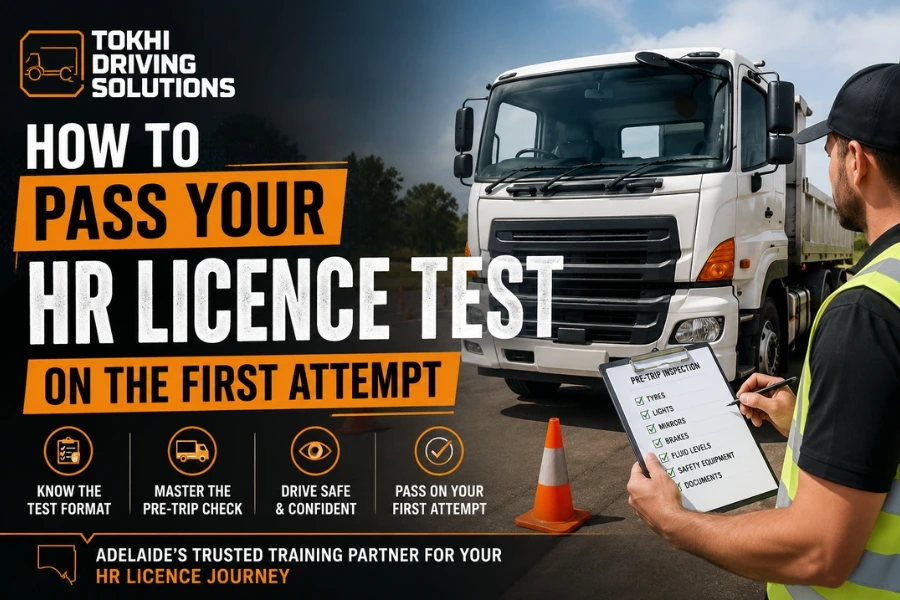
The pre-trip inspection is scored separately and is one of the most frequently failed components. Practise this sequence out loud before test day.
Exterior checks:
- Tyres: visible damage, wear, and inflation across all wheel positions including dual rears
- Lights: headlights, tail lights, brake lights, indicators, and reverse lights
- Mirrors: correctly adjusted and undamaged
- Fuel cap: secure, no leaks
- Body and chassis: obvious damage or loose panels
Under-bonnet checks:
- Engine oil, coolant, brake fluid, and power steering fluid levels
- Battery condition (visual)
In-cab checks:
- Service brake and park brake function
- Steering wheel play
- Air pressure gauge (if air brakes fitted)
- Windscreen condition and wipers
- Seatbelt function
- Horn
- Safety equipment: fire extinguisher, first aid kit, wheel chocks
- Licence and registration documents
Narrating each step as you go helps the examiner follow your process and signals that you have not skipped anything.
How to Prepare for the Practical Test
Get the right vehicle time. A heavy rigid truck handles very differently to a car. Turning radius, stopping distances, and blind spots all require specific adjustment. The HR truck driving course in Adelaide provides structured training in an HR vehicle with instructors who know the exact test criteria.
Make your observations visible. A consistent examiner complaint is that candidates observe without making it obvious. Check mirrors every five to eight seconds on open road. At intersections, turn your head visibly. This signals genuine situational awareness.
Manage speed proactively. Heavy vehicles take significantly longer to stop. The examiner watches whether you plan ahead and reduce speed before having to brake hard. Gradual, anticipatory slowing earns more marks than late, heavy braking.
Practise reversing slowly. A controlled, slow reverse using mirrors is assessed far more positively than a rushed one that clips a cone or kerb. Stop and reposition if needed.
Choose your transmission wisely. If you are unsure whether to train on manual or automatic, the manual vs automatic truck licence for beginners article helps clarify which suits your situation before you commit to training.
Common Reasons People Fail the HR Test
The article on common mistakes to avoid during a trucking commercial driving test covers this thoroughly, but the core failure patterns are:
- Skipping or rushing the pre-trip inspection. Candidates who have not practised the sequence consistently forget steps or complete them out of order.
- Poor observation. Not checking mirrors regularly or failing to scan visibly at intersections is a red flag for any examiner.
- Speed management errors. Maintaining the speed limit regardless of conditions is assessed as poor judgement in a heavy vehicle.
- Wide turns crossing lane lines. Heavy rigid vehicles need wider arcs. Driving them into turns as you would a car frequently results in crossing lane markings.
- Insufficient vehicle hours. No amount of theory substitutes for actual practice in the right vehicle.
For broader context on what influences test outcomes across SA, the article on how to lower HR licence test failure rates is worth reading before your test date.
Quick Answer: What are the most common reasons for failing the HR licence test?
Rushing the pre-trip inspection, insufficient mirror checks, poor speed management, wide turns crossing lane lines, and not having enough hours in a heavy rigid vehicle are the most frequent causes of first-attempt failure.
What to Expect on Test Day in Adelaide
- Arrive 15 minutes early with your licence and required documentation.
- The examiner will explain the format before you begin.
- If you do not hear an instruction clearly, ask for clarification before acting.
- If you make a minor error, keep driving well. One mistake does not end the test.
- After the drive, the examiner will debrief you on your performance.
For a full walkthrough of the process from booking to the day itself, the article on preparing for your truck driving test is a practical reference.
Quick Answer: How long does the HR licence practical test take?
The HR practical test in SA typically takes between 45 minutes and one hour, covering the pre-trip inspection and on-road driving. Allow additional time for pre-test administration
What Happens After You Pass?
Your HR licence is issued through Service SA. From there, you can legally drive heavy rigid vehicles across SA and all other Australian states under reciprocal arrangements. Demand for qualified HR drivers in Adelaide and across SA remains strong. The article on HR licence driver demand in Australia gives a current view of the employment market.
Once experienced, many HR holders progress toward an unrestricted HR truck licence or continue up the hierarchy toward the road ranger licence.
Conclusion
Passing the HR licence test on the first attempt comes down to structured preparation: know the format, practise the pre-trip inspection until it is automatic, get genuine time in the right vehicle, and understand what the examiner is actually assessing at each stage.
If you are ready to start training with instructors who know exactly what it takes to pass, Tokhi Driving Solutions offers professional HR truck licence training across Adelaide. Book your session today and move forward with confidence.
FAQ
1. What does the HR licence test include in SA?
It includes a computer-based knowledge test on road rules and heavy vehicle regulations, followed by a practical on-road assessment covering the pre-trip inspection, reversing, and supervised road driving.
2. How many training hours do I need before the test?
There is no mandatory minimum in SA. Most candidates require one to three days of structured training depending on their prior experience. Those starting from a car licence typically need more time than existing MR holders.
3. Can I supply my own vehicle for the HR test?
Yes, provided it meets HR class requirements, is currently registered, and is roadworthy. Many candidates use a vehicle supplied by their driving school to ensure compliance.
4. What happens if I fail the HR test?
The examiner will provide specific feedback on what did not meet the required standard. You can rebook and retrain on those areas. Additional test fees apply.
5. How much does the HR test cost in SA?
Test fees are set by Service SA and updated periodically. Check the current schedule on the SA Government website. Training costs are separate. The article on key factors that affect HR licence training costs explains what drives overall pricing.
6. How long does the full process take from start to HR licence?
It depends on your current licence class and training needs. For a realistic timeline based on different starting points, the article on how long does it take to get an HR licence breaks it down clearly.
7. Is the HR licence valid in all Australian states?
Yes. An HR licence issued in SA is recognised across all states and territories. If you relocate, you will generally need to transfer your licence to the new state within a set timeframe.
8. Do I need a medical to get my HR licence in SA?
It depends on your age, health history, and whether the licence is for commercial use. Confirm your specific requirements with Service SA or a licensed medical practitioner before applying.