
Truck braking distance is a key topic for every heavy vehicle driver. A loaded truck is far heavier than a passenger car and carries a lot of momentum, so it needs much more road to stop.
The Australian Government Road Safety Data Hub reports that in the 12 months to June 2026, 116 people died in crashes involving an articulated truck, 10 of them in South Australia. Here is how truck braking distance works and how to keep it under control. Learn everything you need to know about truck braking distance below!
Stopping Distance Is Two Distances, Not One
Braking distance and stopping distance are easily confused. Total stopping distance combines two parts:
- Reaction distance: how far you travel from spotting a hazard to getting your foot on the brake.
- Braking distance: how far the truck travels from when the brakes begin to slow it until it stops.
- Total stopping distance: both added together, and the only number that matters in real traffic.
Heavy Vehicle Stopping Distance
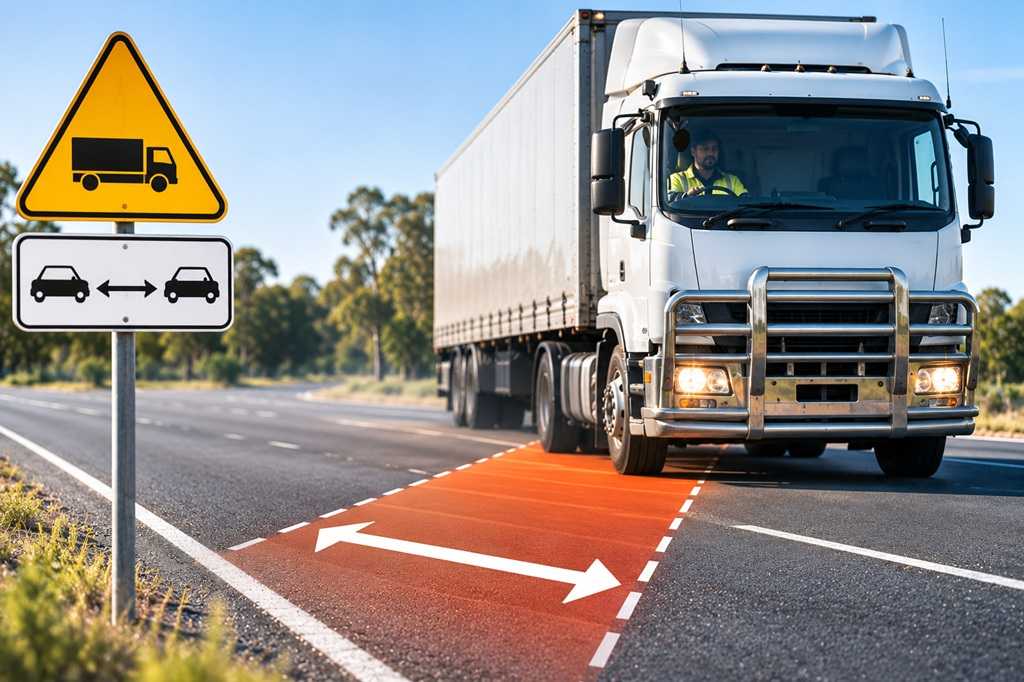
Heavy vehicle braking distance is in a different league from a passenger car’s. The heavier the vehicle, the harder it is to bring to a halt, and a fully loaded truck carries a lot of mass and momentum.
- A heavily loaded truck at 80 km/h needs roughly 60 metres to brake to a stop, before you add reaction distance.
- Air brakes have a short delay between pressing the pedal and the brakes taking effect, which adds to your stopping distance.
- Treat any published figure as a guide, not a certainty. Load, brake adjustment, tyre condition, road gradient and road surface all change the actual distance.
| Speed | Reaction distance (1.5 sec) | Braking distance | Total stopping distance |
| 60 km/h | About 25 m | About 35 m | About 60 m |
| 80 km/h | About 33 m | About 62 m | About 95 m |
| 100 km/h | About 42 m | About 97 m | About 140 m |
Speed Punishes You Harder Than It Feels
Braking distance does not rise in step with speed. It rises with the square of speed, so doubling your speed roughly quadruples the distance you need to stop. Going from 40 to 80 km/h, for example, needs about four times the braking distance.
Even a smaller increase costs you. The table shows that moving from 80 to 100 km/h adds about 35 metres to your braking distance. That extra speed barely registers in the seat, but your brakes, tyres and the road all pay for it. Keeping a few km/h in reserve gives you a lot more room when something goes wrong.
Wet Roads and Worn Tyres Add Even More Distance
Dry bitumen in good condition is your best case. Rain, worn tyres and tired brakes all reduce grip, and every metre lost to reduced grip is a metre you need to stop.
- On a wet road, braking distance can be significantly longer, often around double or more, depending on the surface and your tyres.
- Worn tyres and poorly adjusted brakes make the gap bigger.
- A proper pre-start inspection catches these problems before they show up at the worst moment.
Adelaide Roads Test These Habits Quickly
Coming off the highway and into town traffic tests a new driver’s speed control fast. Experienced drivers plan ahead, and you can too.
- Select your gear before a descent, not during it. Control your speed before you reach the top of a hill, rather than trying to recover it halfway down.
- Leave more space in traffic and when merging. Extra room is the easiest margin to build.
- Practise with an instructor. Reading about braking distance helps, but real driving practice makes it second nature.
Leave Extra Space, Every Time
Physics doesn’t bend for anyone, and the safest drivers plan around it. They manage their speed, keep a generous gap and treat every published stopping figure as a minimum. Leaving an extra second or two of space costs almost nothing, and it can prevent a serious crash.
Tokhi Driving Solutions helps new truck drivers in Adelaide develop safe driving habits and build confidence before their licence test. We also offer LR, MR and HR licence training in Adelaide. Book your driving lessons today and take the next step towards getting your truck licence with confidence!